First Time Camping in Australia?
Don’t Make These Mistakes (2026 Guide)
Affiliate Disclosure: Hey Reader! This post contains affiliate links. When you buy through our links, Pack & Pitch may earn a small commission, at no extra cost to you. Learn more here
As an Amazon Associate, we earn from qualifying purchases.
TL;DR: The No-Rookie Survival Guide
The single biggest mistake first-timers make is focusing on what to buy instead of what to do. You can have the best tent money can buy and still have a terrible first trip if your water system fails, your power dies overnight, or you become “that person” at the campsite. Here’s the three-step fix:
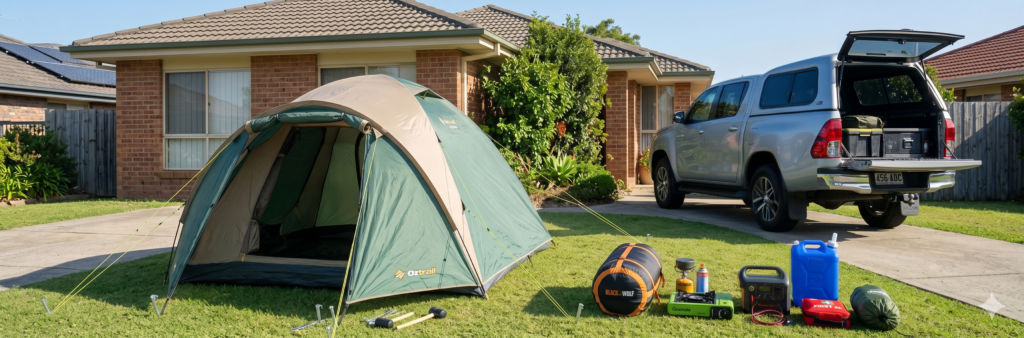
🏆 The Systems: Run a full Driveway Test the night before, pitch the tent, test the stove, and run your power station overnight, so nothing surprises you in the dark at Nundle.
⚙️ The Etiquette: Manage your grey water correctly, keep generator use to daylight hours only if permitted, and don’t park your car on someone else’s patch.
🔋 The Essentials: A stocked first aid kit, reliable LiFePO4 power, and enough water for more than just drinking.
Most first-trip disasters aren’t about gear, they’re about systems and etiquette. Buy less, prepare more. Arrive before 4pm, do a full driveway test the night before, and never assume a tap is drinkable. The people who ruin their first trip aren’t the ones with the cheapest gear. They’re the ones who skipped the boring bits.
The thing nobody tells first-timers
Camping forums are full of gear advice. What they rarely cover is the stuff that actually gets people in trouble: arriving too late to set up before dark, draining the car battery overnight because nobody explained how 12V draw works, and making enemies of every neighbouring campsite within earshot by running a generator at 9pm.
The expensive setup isn’t the answer. Most gear failures are preparation failures. And most etiquette problems are just ignorance, the kind that’s completely fixable if someone tells you beforehand.
This guide does that.
The social contract: how not to be “that camper”
The single biggest fear first-timers have isn’t wildlife or weather. It’s accidentally breaking the unwritten rules and having the whole campsite turn against them. Most of those rules aren’t written anywhere official, but break them and you’ll know about it.
Generator etiquette – the number one complaint in every AU camping group
If there’s one thing that gets campers genuinely angry, it’s a generator running after dark. It doesn’t matter how quiet the model is. The issue is the principle.
Many parks across Queensland, and an increasing number of national parks in NSW and Victoria, either prohibit generators entirely or restrict them to specific hours. If you’re in a park that permits them, the accepted rule is simple: inverter generators only, and only between 8am and 8pm. If you need power overnight for a medical device, a fridge, or charging gear, a portable LiFePO4 power station does all of that silently without annoying anyone. As more parks tighten restrictions, they’re becoming the practical default anyway.
One other thing: always check the park-specific rules before you leave. What’s permitted at a holiday park near the highway is not necessarily permitted at a national park campground. Look it up, don’t assume.
Grey water management – the rule that’s actually tightening
Grey water is the wastewater from your sink, camp shower, or dishwashing bucket. It’s not the same as sewage, but it’s not clean either – it contains soap, food particles, and bacteria that don’t belong in the bush or in a waterway.
The old approach of just letting it drain onto your site or into the scrub is becoming illegal in more areas across Australia, particularly in self-contained camping zones and national parks. The rule now is: collect it, carry it out, and dispose of it only at designated dump points. Spots like Kershaw Gardens in Rockhampton have faced access restrictions precisely because enough campers got this wrong, grey water dumped on grass kills it, creates a hygiene problem, and gives land managers an easy reason to close a free camp for everyone.
A portable grey water tank or catchment bucket is the solution. They’re cheap, pack flat, and mean you’re covered whether the site has a dump point or not. The WikiCamps and Hema Explorer apps both show where dump points are located, which is useful if you’re touring between camps.
For more on what you can and can’t do with waste at different types of camping areas, our free camping rules guide covers the legal specifics by state.
Three systems that will make or break your first trip
New campers spend time choosing gear. The ones who have good first trips spend time checking their systems. These three are where things go wrong.
The power system
A standard lead-acid car battery cannot run a camping fridge, charge phones, power lights, and run a CPAP machine overnight without either flattening itself or damaging the battery. This is not a maybe – it will happen if you try it long enough.
The baseline for a practical camping power setup in 2026 is a dedicated 500Wh–700Wh LiFePO4 power station. It sits in the back of the car, runs everything off its own battery, and gets topped up by solar or from the car while you’re driving. Your car battery stays untouched. See our portable power station guide for current models and how to size it to your specific load.
If you or your partner uses a CPAP machine, there’s an extra consideration: running it through an inverter wastes 15–25% of your battery overnight. The fix is a $30 DC converter cable and turning off the humidifier. Our complete CPAP camping guide covers exactly how to set it up.
The water system
The standard advice is to bring more water than you think you need. It’s good advice. What most guides don’t mention is what to do when the campsite has a tap.
Never assume a camp tap is potable unless it’s explicitly signed as such. Untreated bore water, tank water that hasn’t been tested recently, and “treat before use” sources all exist across Australian campgrounds. Drinking from the wrong tap can ruin a trip faster than bad weather.
A Sawyer Squeeze or LifeStraw inline filter weighs almost nothing, fits in a pocket, and filters bacteria and protozoa from any freshwater source. Keep one in your kit and you’re covered whether the tap situation is clear or questionable.
Water needs beyond drinking: plan for cooking, dishwashing, washing hands after handling raw meat, and a basic wash if you’re out more than a night. For a family of four over three days, 20 litres disappears faster than you’d expect, especially in summer. Budget at least 4 litres per person per day as your minimum, then add a buffer.
The safety system
Most people camping for the first time think they won’t need a first aid kit because nothing bad will happen. This is the wrong way to think about it. You bring a first aid kit not because you expect trouble but because you’re an hour from a hospital and the gap between a manageable situation and a serious one is often a clean bandage and a pair of tweezers.
A stocked camping first aid kit is non-negotiable. We’ve reviewed the Survival range specifically – they’re Australian-designed, available on Amazon AU, and each kit is labelled so you can actually find what you need under pressure. For families the Family Kit is the right call; if you’re hiking in snake country the Snake Bite Kit with the smart tension-indicator bandage is worth having as well. At minimum any kit should include wound care (dressings, bandages, antiseptic), pain relief, tweezers, a triangular bandage, and an emergency blanket. Going somewhere remote, add a tourniquet.
Before heading into an area with variable mobile coverage, also check our snake safety guide – it’s basic knowledge that matters a lot more than most people realise on a warm afternoon in the bush.
The driveway test
This is the most important single piece of advice in the guide. It has its own section because people skip it, and it’s the reason their first trip goes badly.
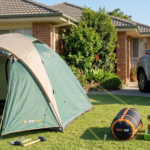
The driveway test: the night before you leave, set up your entire camp in your driveway or backyard.
Pitch the tent. Locate every peg and pole. Test the stove with a full gas canister. Check that all bedding fits and is actually warm enough. Run the power station overnight and check the reading in the morning. Fill the water containers and make sure none of them leak.
This takes two hours and costs nothing. What it does is convert “I think this works” into “I know this works.” Problems that would ruin your Friday night at the campsite become Tuesday afternoon problems in your driveway, where you have time to fix them.
Use this alongside the Ultimate Camping Checklist – which has a downloadable PDF – to make sure nothing gets missed. The checklist and the driveway test together are worth more than any gear upgrade.
Arrival and timing
Getting this wrong is how you end up setting up a tent in the dark, on ground you can’t properly see, with tired kids and a dying headtorch.
Aim to arrive at your campsite before 4pm. This gives you enough light to: choose a good pitch, check the ground for ant nests and drainage issues, set up the tent and sleep area properly, get the kitchen organised, and feed everyone before it’s fully dark.
4pm sounds early, but factor in that most camping destinations are at least 2–3 hours from major cities, and that a car packed for camping loads and unloads slower than it looks on YouTube.
Two other things to do on arrival before you unpack anything: walk the site once, check where the toilets are, and look at which direction the ground slopes. You do not want to discover at 2am that your tent is at the bottom of a gentle slope and that rain water has nowhere to go except into your groundsheet. Our 7-Zone campsite setup guide covers exactly how to lay out your site once you’ve picked the right spot.
Maps, weather and going offline
Mobile reception disappears faster than most first-timers expect. A 4G signal in the carpark does not mean a signal 500 metres down the dirt track to the campsite.
Before leaving, download two things:
- Hema Explorer or WikiCamps Australia with offline maps for your region. Both work without reception once downloaded. WikiCamps shows campsite locations, water points, and dump points. Hema is better for 4WD track navigation.
- A local weather forecast screenshot. Forecasts don’t update without reception, so check in the 12 hours before you leave, not the week before.
The weather point is worth emphasising. Australian weather, particularly in coastal and alpine areas, can change meaningfully within hours. A forecast that looks fine at 8am can include afternoon storms by 2pm. Always check the Bureau of Meteorology forecast for the specific region, not just the nearest town. For summer trips, also check if there are any fire bans in effect – our fire ban and safety guide explains exactly what you can and can’t do with a camp stove during a total fire ban.
Picking the right first spot
The best first campsite is not the most remote one you can find. It’s one that’s close enough to home that if something goes wrong (weather turns, gear fails, someone gets sick) you can leave without it being a disaster.
For Sydney-based campers, the spots covered in our 15 best campsites near Sydney list sit within a 3-hour drive and give you real bush camping without being so remote that a small problem becomes a big one.
For a broader view of NSW options, the best camping in NSW guide covers 13 campgrounds by region, with honest notes on what each one is actually like.
Start local. Get a successful trip under your belt. Then go further.
FAQ
Related reading on Pack & Pitch
- Why I Ditched My Supermarket First Aid Kit – our review of the Survival range, including which kit is right for hikers vs families vs 4WD trips
- The 7-Zone Campsite Setup System – the best way to organise your site so everything is where you need it when you need it
- Ultimate Camping Checklist: 100+ Essentials – the pre-trip list with a downloadable PDF, designed for AU/NZ conditions
- No-Stress 3-Day Camping Meal Plan – what to actually cook, with a shopping list and zero food waste
- Free Camping Rules in Australia and NZ – where you can legally camp for free and what the self-containment rules actually mean
- How to Power a CPAP Machine While Camping – if anyone in the family uses a CPAP, read this before the trip
- Best Portable Power Stations Australia 2026 – how to choose the right station for your load
Last reviewed April 2026.
Latest Posts
- Camping With an EV or Hybrid in Australia 2026: Can You Run a 12V Fridge?
 EVs and hybrids have no alternator, so a dual-battery setup is out. Here is how V2L actually works for camping, which AU models have it, and what a fridge costs you in range.
 - Best Camping Headlamps: From Serious Gear to Panda Faces (2026)A dead headlamp at 11pm ruins the whole trip. We’ve filtered Amazon AU down to 6 headlamps that actually hold up in Australian conditions — including the one that already converted a real sale.
- Winter Camping Australia 2026: The Sleep System & Layering GuideAU winter camping done properly. The sleep system that keeps you warm at -5C, the layers that beat cotton-kills hypothermia, the AU regions and what gear they actually need. Driveway-tested, ProductReview-cross-checked.
- First Time Camping in Australia? Don’t Make These Mistakes (2026 Guide)Most first camping trips fail on systems, not gear. Generator rules, grey water, the driveway test, and what to actually pack. The honest beginner’s guide for Australian conditions.
- How to Power a CPAP Machine While Camping in Australia (2026 Guide)Running a CPAP off-grid doesn’t need an expensive inverter setup. The right 12V cable, the right settings, and a 500Wh station will cover most people for 3–5 nights. Here’s exactly what to buy and how to set it up.