Jackery vs EcoFlow Australia 2026:
Which Power Station Is Actually Worth Your Money?
Affiliate Disclosure: Hey Reader! This post contains affiliate links. When you buy through our links, Pack & Pitch may earn a small commission, at no extra cost to you. Learn more here
As an Amazon Associate, we earn from qualifying purchases.
TL;DR: The 2026 Power Showdown
If you’re dropping $3,000+ on an off-grid system, the “best” unit depends entirely on how you camp:
The Tech Pick: EcoFlow Delta 3 Plus – Best for “last-minute” Dads. It hits 0–80% charge in 47 minutes (faster than you can pack the car) and comes with a 5-year warranty. It’s the spec-leader, but the fans can be loud under load.
The Outback Pick: Jackery Explorer 2000 Plus – Best for the “sleep-near-it” Dad. It’s whisper-quiet, built like a Hilux for 45°C heat, and can be expanded up to 24kWh as your family grows. It’s slower to charge than the EcoFlow, but significantly more rugged.
The “Weekend Warrior” Pick: Jackery Explorer 1000 v2 – The “Goldilocks” unit. Light enough for a RAV4 boot but runs a 60L fridge for 48 hours easily.
The Problem Nobody Talks About Honestly
Three days into a trip at Coolendal. Sky has turned that familiar grey. Your old AGM battery is at 11.2V and dropping.
You’ve got two options: run the car for two hours and annoy every camper within 500 metres, or eat warm sausages and drink hot beer by sunset.
Most people reading this have been there. That low-grade dread of watching the voltage tick down is what’s pushing more Aussie families toward all-in-one solar generators. They’re safer than a DIY dual-battery setup, easier for renters and camper-trailer owners who can’t wire a second battery, and genuinely useful outside of camping. Run the fridge during a summer blackout. Charge tools in a remote workshop.
The use cases stack up.
But if you’re spending $2,000 to $4,000 on a lithium power station, you need to know exactly what you’re buying. Jackery and EcoFlow are the two dominant brands in Australia right now, and they’ve taken almost opposite approaches to building a portable power station. Neither is objectively “better.” They’re better for different people.
This guide cuts through the marketing and tells you which one fits the way you actually camp.
What’s New in 2026 Worth Knowing
Before getting into the head-to-head, two things have changed in the Australian market this year that affect which unit makes financial sense.
The expandable power station now makes sense as a home backup investment. Both the EcoFlow Delta 3 series and the Jackery 2000 Plus are eligible for use under Australia’s home battery rebate programs in several states. If you’re buying a larger expandable system, run the numbers. Buying through the Official Amazon AU Store gives you the GST receipt you need for any claim, and the unit doubles as a blackout buffer on hot summer nights when the grid gets wobbly.
The price war between these two brands is very real right now.
Both have official Amazon AU stores and both run coupon deals regularly. Before you check out, look for the “Apply Coupon” checkbox on the listing page. It’s easy to miss and I’ve seen it knock $300 to $500 off the advertised price during peak deal periods.
EcoFlow Delta 3 Plus
The Tech Titan
If EcoFlow is your pick, you’re prioritising speed and future-proofing over simplicity.
Charging Speed
This is where EcoFlow has pulled ahead of everyone else in the Australian market. The Delta 3 Plus goes from flat to 80% in under 50 minutes on a standard 240V wall outlet. That’s not a lab figure designed to impress a spec sheet. It’s genuinely useful when you’ve procrastinated packing until Sunday morning and realise nothing is charged.
No other brand currently available in Australia is close to that number at this price point.
Solar Input
The Delta 3 Plus accepts up to 1,000W of solar input through dual MPPT ports. In practical terms: if you’ve got 800W of panels set up and the sun is cooperating, you’re back to full charge in two to three hours. For families who park up for three or four days and rely on solar rather than grid charging, this input ceiling matters a lot.
The 5-Year Warranty
EcoFlow’s current 5-year warranty on the Delta 3 series is a meaningful advantage. Most competitors offer two or three years. For a unit that costs $2,500 to $3,500 depending on capacity, knowing you’re covered until your primary-schooler is nearly in high school changes the maths on the purchase. Warranty claims are handled through local logistics, not international shipping.
The Honest Catch? Fan Noise
The Delta 3 Plus runs warm under load, and the fans know it. When you’re fast-charging or pulling serious wattage (think electric kettle, air fryer, or charging a laptop while running a fridge), the fans sound like a small drone. Not catastrophic in a large annex or outside in a campsite. Noticeable if the unit is sitting a metre from where you’re trying to sleep in a small van or camper trailer.
EcoFlow has an “X-Boost” mode that lets the unit power appliances rated above its continuous output by stepping down voltage, which is handy for running a 2400W air fryer without tripping the internal protection. But the fan noise that comes with it is the trade-off nobody mentions in the unboxing videos.
Who It’s For?
You’re the right buyer for the EcoFlow Delta 3 Plus if you: regularly forget to charge before leaving, value fast solar recovery over maximum silence, run the unit in a separate compartment or outside, and want the longest warranty on the market.
Check latest price at the Official EcoFlow AU Store on Amazon
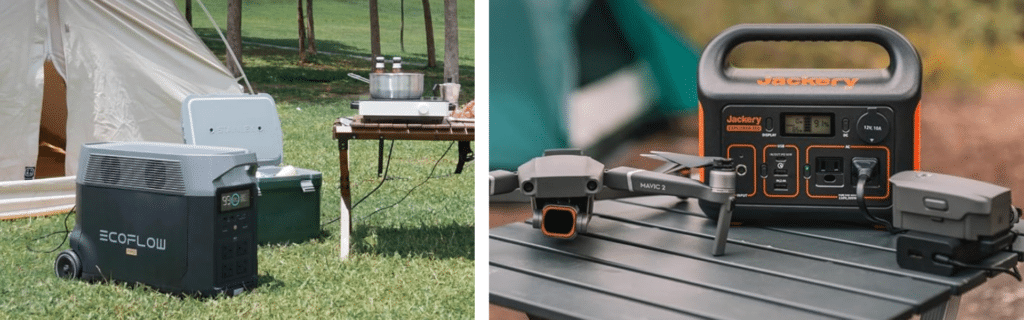
Jackery Explorer 2000 Plus The Outback Tank
If Jackery is your pick, you’re prioritising silence, durability, and simplicity over raw charging speed.
Fan Noise (or Lack of It)
This is Jackery’s biggest real-world advantage over EcoFlow. The thermal management system in the 2000 Plus runs the unit cooler under standard loads, which means the fans either don’t spin up at all or run at a very low speed. When you’re sleeping a metre away from your power station in a small tent or swag setup, the difference between 30dB and 50dB is the difference between sleeping and not sleeping.
If you have a light sleeper in the family, a small trailer, or you tend to keep the unit in the living area of a camper, this matters more than any charging speed figure.
Build Quality and Heat Tolerance
In 40-degree-plus conditions, which are realistic across large parts of Australia for four to five months of the year, the Jackery’s cooling design holds up better under sustained load.
The handles are solid reinforced plastic, not the trim-fit handles you find on lighter units. It’s built to be grabbed, dragged over a corrugated tailgate, and used hard.
The 2000 Plus is rated for 4,000+ charge cycles to 70% capacity. If you used it every single day, it would still be performing acceptably in 2036. Most families won’t cycle it daily, which means this unit should genuinely outlast the family camping phase.
The Modular Expansion System
The smartest thing Jackery did with the 2000 Plus was making it expandable via stacking battery packs. You start with the base unit. When the budget allows, or when the camping trips get longer, you stack another “PackPlus” battery on top and double the capacity. The system scales to 24kWh, which is enough to run a small house for several days.
This matters for families. Your power needs in 2026 are not the same as they’ll be in 2029 when you’ve upgraded the camper trailer, added a second fridge, and started running a CPAP machine or a 12V shower pump. The modular approach means you’re not buying a whole new unit as the setup grows.
The Interface
No app required if you don’t want one. Big physical buttons, a clear LCD readout showing input, output, and state of charge. You can operate it half-asleep at dawn without needing to unlock a phone. That’s not a small thing when you’ve got kids asking questions and coffee to make.
The Honest Catch? Charging Speed
Jackery can’t match EcoFlow on wall charging speed. The 2000 Plus gets to 80% in roughly 100 minutes on AC. That’s not slow for a 2kWh unit, but it’s double the EcoFlow. If you’re in a consistent routine of charging overnight at home before every trip, it doesn’t matter. If you regularly need a rapid top-up, it does.
Solar input maxes at 1,200W, which is actually higher than the EcoFlow Delta 3 Plus. So if solar is your primary charging source, the gap in real-world performance narrows considerably.
Who It’s For?
You’re the right buyer for the Jackery Explorer 2000 Plus if you: camp in smaller tents or trailers where noise matters, expect to expand your setup over time, camp in hot conditions regularly, and prefer a simple interface over app-connected features.
Check latest price at the Official Jackery AU Store on Amazon
2026 Comparison: The Honest Numbers
| Feature | EcoFlow Delta 3 Plus | Jackery Explorer 2000 Plus | What It Actually Means |
|---|---|---|---|
| Battery Chemistry | LiFePO4 | LiFePO4 | Both are the safe, long-life chemistry. Tie. |
| AC Charge Speed | 0-80% in ~47 mins | 0-80% in ~100 mins | EcoFlow wins if speed matters to you |
| Solar Input (Max) | 1,000W | 1,200W | Jackery edges it on solar top-up |
| Fan Noise Under Load | Moderate to loud | Whisper quiet | Jackery wins for sleep-near-it use |
| Continuous AC Output | 3,000W | 3,000W | Tie. Both handle an air fryer easily |
| Expandable Capacity | Up to 6kWh | Up to 24kWh | Jackery wins for long-term scaling |
| Weight | ~23kg | ~28kg | EcoFlow is a bit easier to move solo |
| AU Warranty | 5 years | 3+2 years (model dependent) | EcoFlow has the cleaner warranty story |
| App Control | Full smart app | Optional | EcoFlow if you like app integration |
| Heat Management | Fan-cooled, can run warm | Passive + low-speed fans | Jackery better in sustained 40C+ heat |
Why I Only Link to the Official Amazon AU Stores
This comes up every time I recommend one of these units. Why not a dedicated 4WD accessories shop? Why not a Flash Sale site?
One reason: logistics.
A unit like the Jackery 2000 Plus weighs 28 kilograms. The EcoFlow isn’t much lighter. If you buy from a small operation and the unit arrives with a fault, a cracked casing from courier handling, or a BMS error that shows up two weeks in, you are dealing with the most painful returns process in retail.
Organising the pickup and return of a 30-kilogram lithium battery classified as hazmat freight is not a fun afternoon.
Both EcoFlow and Jackery operate Official Stores on Amazon AU. Buying through those stores means:
Stock is sitting in Sydney or Melbourne distribution centres. Delivery is typically 48 hours on Prime. No waiting three weeks for something shipped from a regional warehouse.
If something is wrong with the unit, Amazon handles the return logistics. They have the systems for heavy, regulated freight. You don’t.
You get a proper Australian GST receipt, which matters if you’re claiming it against a home battery rebate or using it for a business.
What If You Don’t Need a $3,000 Unit?
A lot of families are running a weekend setup: a 40 to 60 litre fridge, phones, a few USB lights, maybe a coffee machine in the morning. For that use case, the bigger units above are overkill.
TheJackery Explorer 1000 v2 hits the sweet spot for weekend warriors. Light enough to carry in one hand (roughly 9 to 10kg), enough capacity to run a small fridge for two nights, and at roughly half the price of the 2000 Plus. It’s the unit I’d buy for someone who camps four or five weekends a year with the family at established campgrounds
The EcoFlow Delta 2 is the equivalent entry point for the EcoFlow side, with the same fast-charging advantage at a smaller capacity and price. If you’re already bought into the EcoFlow ecosystem and want fast top-up on a tighter budget, start here.
Check the Jackery 1000 v2 on Amazon AU | Check the EcoFlow Delta 2 on Amazon AU
What About Full-Timers and Grey Nomads?
If you’re running a caravan or fifth-wheeler full-time, or doing extended remote touring, the 2000 Plus and Delta 3 Plus are starting points rather than endpoints.
The EcoFlow Delta Pro Ultra is built for whole-home backup and extended off-grid living. It integrates with solar inverters, smart home systems, and can be expanded to very large capacities.
The technology is genuinely impressive. It is expensive and complex, and you’ll get the most out of it if you’re comfortable with the app and the ecosystem.
The Jackery Explorer 3000 Pro with expansion batteries is the equivalent Jackery option for extended touring. Higher base capacity, still quiet, still the simple interface.
For full-timers, I’d also suggest getting a quote from a specialist 12V installer. A purpose-built lithium battery system integrated with your vehicle’s alternator and a proper MPPT solar controller will outperform any portable unit for sustained off-grid living.
These all-in-one generators are excellent for families doing multi-week trips. They are not always the most efficient solution for a full-timer parked up for six months.
Your Questions, Answered
The Verdict
Get the EcoFlow Delta 3 Plus if: speed is your priority, you want the strongest warranty in the category, you charge primarily from 240V rather than solar, and fan noise isn’t a concern for your setup.
Get the Jackery Explorer 2000 Plus if: quiet operation matters because your unit lives close to where you sleep, you expect to expand capacity over time, you camp in sustained high heat, or you want something with a dead-simple interface.
Get the Jackery 1000 v2 if: you’re doing weekend trips, running a modest load, and don’t want to spend more than $1,200.
Get nothing yet if: you’re still running short weekend trips to established campgrounds with powered sites. Save the cash and come back when the use case justifies it.
One last tip before you buy: add your preferred unit to your cart, then check the product listing page for an “Apply Coupon” button before checking out. Both brands run coupon-based discounts regularly, and it’s easy to miss. I’ve seen $400 to $500 knocked off that way on no-sale weeks.
Further Reading
- Best Camping Fridges Australia 2026 – See exactly how much power each fridge model draws, so you can size your battery correctly.
- Best Family Tents Australia 2026 – Once the power’s sorted, make sure the shelter is too.
- Best Portable Gas Stoves for Families – Pair your power station with the right cooking setup and ditch the need for a 240V cooktop.
- Best Camping Chairs Australia – The full camp setup guide for families who want comfort without the bulk.
- Summer Camping Packing Checklist Australia – Don’t leave for a trip without running through this first.
- How to Keep Food Fresh Camping Without a Fridge – Useful if you’re still on the fence about whether a powered setup is worth it for your trips.
- How to Camp Safely in Snake Country – A full battery won’t help much if you’re not watching where you step.
Latest Posts
- Camping With an EV or Hybrid in Australia 2026: Can You Run a 12V Fridge?
 EVs and hybrids have no alternator, so a dual-battery setup is out. Here is how V2L actually works for camping, which AU models have it, and what a fridge costs you in range.
 - Best Camping Headlamps: From Serious Gear to Panda Faces (2026)A dead headlamp at 11pm ruins the whole trip. We’ve filtered Amazon AU down to 6 headlamps that actually hold up in Australian conditions — including the one that already converted a real sale.
- Winter Camping Australia 2026: The Sleep System & Layering GuideAU winter camping done properly. The sleep system that keeps you warm at -5C, the layers that beat cotton-kills hypothermia, the AU regions and what gear they actually need. Driveway-tested, ProductReview-cross-checked.
- First Time Camping in Australia? Don’t Make These Mistakes (2026 Guide)Most first camping trips fail on systems, not gear. Generator rules, grey water, the driveway test, and what to actually pack. The honest beginner’s guide for Australian conditions.
- How to Power a CPAP Machine While Camping in Australia (2026 Guide)Running a CPAP off-grid doesn’t need an expensive inverter setup. The right 12V cable, the right settings, and a 500Wh station will cover most people for 3–5 nights. Here’s exactly what to buy and how to set it up.