How to Power a CPAP Machine
While Camping in Australia (2026 Guide)
Affiliate Disclosure: Hey Reader! This post contains affiliate links. When you buy through our links, Pack & Pitch may earn a small commission, at no extra cost to you. Learn more here
As an Amazon Associate, we earn from qualifying purchases.
TL;DR: Off-Grid CPAP Power
The single biggest mistake CPAP campers make is running their machine through an inverter. Stop doing that. A 12V DC converter cable costs about $30 and immediately gives you 15–25% more runtime from the same battery. If you also turn off the humidifier, a 500Wh power station will comfortably last most people 3–5 nights. Two machines? Budget 1000Wh minimum. The expensive setup isn’t the answer. The right setup is.
The Three-Step Fix:
🏆 The Cable: Skip the inverter and buy a Shielded DC Converter Cable for your specific machine (ResMed, Philips, etc.) to stop wasting battery on heat.
⚙️ The Settings: Turn OFF your heated humidifier; it’s a “power hog” that can drain a battery in one night versus four nights without it.
🔋 The Battery: Use a 500Wh–700Wh LiFePO4 power station for single users or 1000Wh+ for couples to ensure you have enough “oomph” to last the trip.
The problem most campers don’t know they have
Every week in Australian camping groups I see someone post a version of the same thing: “Set up at [insert your favourite remote spot here]. CPAP died at 2am. Help.”
Usually they’ve bought a decent battery, maybe even a quality inverter, and it still isn’t lasting the night. They assume the battery is faulty or undersized. Most of the time, neither is true.
The actual problem is almost always one of two things: they’re wasting power through unnecessary conversion, or their CPAP settings are quietly draining the battery for them. Sometimes both.
This guide fixes both. No upselling you into a $3,000 setup. Just what actually works in the bush.
The myth that keeps killing batteries
The most common advice you’ll see in camping groups goes like this: “Just get a bigger inverter. More watts, more power.”
This is well-meaning and completely wrong for CPAP users.
A bigger inverter doesn’t solve the actual problem. It just makes the inefficiency harder to notice for longer.
Here’s why. Your CPAP runs on DC power. Your battery also stores DC power. But when you run the CPAP through an inverter, you’re converting DC to AC so the machine’s power brick can convert it straight back to DC again. That double conversion burns 15–25% of your battery capacity as heat before your machine even turns on.
You can scale up the inverter to 2000W and you’ll still be wasting a quarter of your battery on a conversion you didn’t need in the first place.
The fix isn’t a bigger inverter. It’s skipping the inverter entirely.
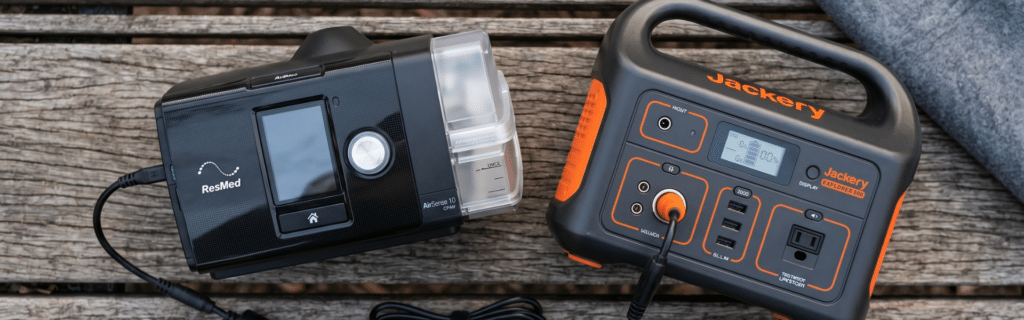
A shielded DC converter cable matched to your machine lets the CPAP pull directly from the battery. ResMed themselves recommend DC converters over inverters for this exact reason. These cables cost $25–50 and work straight out of the box. The three machines you’re most likely to be running in Australia:
- ResMed AirSense 10 or 11 – buy direct from the ResMed AU shop or EasyCPAP
- Philips DreamStation 2 – search “DreamStation 2 DC converter cable” on Amazon AU or your CPAP supplier
- Fisher & Paykel SleepStyle – search “SleepStyle 12V travel cable” on Amazon AU or contact your supplier
Each uses a different connector, so make sure you’re ordering for your specific model. If you’re not sure what machine you have, check the sticker on the bottom.
What your CPAP is actually drawing: the numbers
This is where most camping power calculations fall apart. People size their battery based on the machine’s maximum wattage rating, then wonder why reality doesn’t match.
The machine’s draw changes dramatically based on settings.
| CPAP feature | Estimated power draw | Effect on a 500Wh battery |
|---|---|---|
| Base machine, pressure 10, no extras | 5–10W | 40–50 hours of runtime |
| + Heated humidifier | +60–100W | Drops total runtime to roughly 4–6 hours |
| + Heated tubing | +15–30W | Reduces runtime by around 30% on top |
| Cellular/Bluetooth active | +1–3W | Small but measurable over 8 hours |
Run everything at once on a 500Wh station and you might not make it to morning. Turn off the humidifier and the same battery covers four or five nights.
This is why “my 500W battery isn’t enough” is almost never a battery problem.
LiFePO4 vs standard lithium-ion: it matters in Australia
Most portable power stations run on one of two battery chemistries. The difference matters more in Australian conditions than anywhere else.
Standard lithium-ion (NMC): Cheaper to buy upfront, lighter, but rated for roughly 500–800 charge cycles before capacity degrades noticeably. Also more sensitive to heat. Leave a standard lithium-ion station in a hot car or a canvas tent in a Queensland summer and you’re shortening its life faster than the spec sheet suggests.
LiFePO4 (lithium iron phosphate): Heavier and more expensive upfront. Rated for 2,000–3,500 cycles depending on the model. More stable chemistry in high temperatures – no thermal runaway risk. Holds capacity better over time.
For a device you rely on medically and plan to use on regular trips for five or more years, LiFePO4 is the straightforward choice. The price premium pays itself back well before you’d be replacing a NMC unit.
The Bluetti EB70 is the most accessible LiFePO4 option at the 700Wh tier on Amazon AU at time of writing. The EcoFlow Delta 2 is worth comparing at the 1000Wh level.
What size do you actually need?
| Setup | Capacity | Realistic runtime |
|---|---|---|
| Quick overnighter, humidifier off | 250–300Wh | 1–2 nights |
| Standard family trip, humidifier off | 500–700Wh | 3–5 nights |
| Heated tubing required, or fridge sharing | 700–1000Wh | 3–5 nights with extras running |
| Two machines (see below) | 1000Wh+ | 3–5 nights for both |
Recommended stations in 2026:
- Jackery Explorer 1000 v2 – proven in dusty Australian conditions, widely stocked, now runs LiFePO4 chemistry (rated 4,000 cycles), solid customer support if something goes wrong
- EcoFlow River 2 Pro – faster solar and AC recharging (around 70 minutes from mains), which matters if you’re driving short distances between camps
- Bluetti EB70 – LiFePO4 chemistry, 2,500-cycle rating, the better long-term buy for regular campers
Can’t decide between Jackery and EcoFlow? We’ve done a full head-to-head comparison covering charging speed, build quality, and value for Aussie conditions. Or see our complete portable power station guide if you want to compare across more brands.
Check stock before ordering. Availability on these units shifts around.
The couples setup: powering two machines overnight
Running two CPAPs from one station is more common than manufacturers would have you think, and it comes up constantly in touring and grey nomad groups.
The short version: 1000Wh is your minimum. With both machines on DC cables, humidifiers off, you’re drawing roughly 15–20W total. A 1000Wh station gives you four to five nights of comfortable dual-machine runtime with capacity to spare.
Where people go wrong is trying to run two machines off a 500Wh station “because it should be enough on paper.” Paper math doesn’t account for charging losses, battery degradation, or the night one of you forgets to turn the humidifier off.
Buy the 1000Wh station. The EcoFlow Delta 2 or Jackery Explorer 1000 v2 are both well-proven for this. If you’re doing an extended lap and want LiFePO4, the Bluetti AC200P is worth considering, though it’s significantly heavier.
One practical note: two DC cables means two different cables if you and your partner have different machine brands. Order both before you leave. The wrong cable on the wrong machine won’t work and you won’t find a replacement at the servo at Cobar.
The settings most people don’t touch (and should)
Getting the right hardware is half the job. The other half is not letting the settings undo it.
Turn off the humidifier first. A heated humidifier pulls 60–100W. Your base machine pulls 5–10W. That gap is the entire difference between four nights of runtime and one. If you’ve never tried sleeping without the humidifier, do the driveway test first (see below). A lot of people find coastal and bush air humid enough that they don’t miss it.
Heated tubing is worth keeping in context. In Tasmania in winter or the Victorian High Country, rain-out (condensation in the tube) is a genuine problem and heated tubing fixes it. In most other Australian camping conditions, it’s unnecessary overnight load. If you genuinely need it, budget 100Ah LiFePO4 minimum and make sure you’re getting solar input during the day.
Turn off cellular and Bluetooth on the CPAP unit. Small saving individually. Over eight hours, every watt counts when you’re three days from the next power point.
Getting the power back in while you’re out there
More than two nights in one spot and you need input.
A 200W folding solar blanket is the practical option for most campers. You can reposition it as the sun moves. No roof rack needed, no permanent installation, rolls up in a bag. For anyone already on a powered site occasionally, you have it covered through the site hookup.
If you’re doing multi-stop trips, check whether your power station supports pass-through charging via a 12V outlet or Anderson plug. Most modern stations do. This lets you charge the station from the ute while it’s simultaneously running the CPAP in the back, which is useful on long driving days between camps.
If you’re also running a 12V camping fridge from the same station, factor that draw in. A 40L fridge cycling at 25–35W average cuts into CPAP runtime meaningfully and pushes most setups from 500Wh into the 700–1000Wh range.
The Jayco/Waeco integration trap. If your caravan has a factory-installed solar controller – common in the Jayco Swan, Eagle, and similar popular AU van models – that controller is almost certainly a Waeco or Setec unit. These were designed to manage a single house battery bank. They were not designed to recognise or communicate with a modern portable power station, and they can’t.
If you try to wire a portable station into the van’s existing 12V system, you’re creating a situation where the van’s battery monitor sees unexpected charge and draw events it can’t account for. The resulting conflicts are annoying to diagnose and occasionally cause the monitoring system to report false low-battery states.
The fix is simpler than it sounds: treat the portable station as its own separate ecosystem. Charge it from the van’s 12V cigarette socket or a dedicated Anderson plug while driving, and let the van’s factory system manage the house battery independently. Two parallel systems, no interference. Using the cigarette socket isn’t a workaround, and for this specific use case, it’s the correct approach.
Before you go: the driveway test
If this is your first time powering a CPAP off a battery, run the whole setup at home overnight before you go anywhere.
Same station, same cable, same CPAP settings as you plan to camp. Check the capacity reading when you wake up. The whole thing takes 20 minutes to set up and removes all the guesswork about whether your numbers actually work in practice.
It’s also worth running through your camping checklist at this point. The driveway test is the right time to spot any other gaps before you’re three hours from town.
Finding out you need to adjust settings is fine in the driveway. It’s not fine three hours from Nundle on a Friday night.
While you’re testing at home: if you don’t have a folding wagon, get one. A fully loaded 1000Wh station weighs around 10–14kg. Dragging it from the car to the tent in the dark on uneven ground is exactly the kind of thing that makes a holiday feel like work. A basic folding flat-bed trolley handles it easily. You won’t find CPAP cables at Bunnings, but you will find the trolley.
Where to actually test this setup
A few spots that come up regularly as practical test camps for gear-heavy setups:
Nundle, NSW – the free camps around the Peel River area are close enough to home for most Sydney and Hunter campers for a quick shakedown trip, but genuinely off-grid. Good for testing a 2–3 night setup before committing to something longer. Looking for more options nearby? See our best NSW campgrounds list, or if you’re Sydney-based, these 15 picks are all within a 3-hour drive.
Cosy Corner North, WA – comes up constantly in southwest WA camping groups as a benchmark for off-grid comfort. No power, no noise, exposed enough that your setup gets a proper test. If your CPAP rig works here for five nights, it’ll work anywhere.
FAQ
Related reading on Pack & Pitch
- Jackery vs EcoFlow Australia 2026: Full Head-to-Head – if you’re choosing between the two most popular stations, this covers charging speed, durability, and which suits which style of camper
- Best Portable Power Stations Australia 2026 – the full guide covering more brands and capacity tiers, useful if you’re also sizing for a fridge or other gear
- Best Camping Fridges Australia 2026 – if a fridge is sharing your battery, this guide will help you understand the draw and size your station accordingly
- Ultimate Camping Checklist: 100+ Essentials – a full pre-trip list for AU/NZ conditions, with a downloadable PDF
- Camping with Kids in Australia: The Complete Guide – for families planning their first off-grid trip with medical gear and kids in tow
All products linked in this post are available on Amazon AU or major Australian retailers. We only link to items currently in stock. CPAP DC cables are best bought directly from the ResMed AU shop or EasyCPAP for the AirSense 10, or via Amazon AU for other brands. ResMed also has a helpful camping power guide on their AU site if you want to cross-check the advice here against the manufacturer’s own recommendations.
Last reviewed April 2026.
Latest Posts
- Camping With an EV or Hybrid in Australia 2026: Can You Run a 12V Fridge?
 EVs and hybrids have no alternator, so a dual-battery setup is out. Here is how V2L actually works for camping, which AU models have it, and what a fridge costs you in range.
 - Best Camping Headlamps: From Serious Gear to Panda Faces (2026)A dead headlamp at 11pm ruins the whole trip. We’ve filtered Amazon AU down to 6 headlamps that actually hold up in Australian conditions — including the one that already converted a real sale.
- Winter Camping Australia 2026: The Sleep System & Layering GuideAU winter camping done properly. The sleep system that keeps you warm at -5C, the layers that beat cotton-kills hypothermia, the AU regions and what gear they actually need. Driveway-tested, ProductReview-cross-checked.
- First Time Camping in Australia? Don’t Make These Mistakes (2026 Guide)Most first camping trips fail on systems, not gear. Generator rules, grey water, the driveway test, and what to actually pack. The honest beginner’s guide for Australian conditions.
- How to Power a CPAP Machine While Camping in Australia (2026 Guide)Running a CPAP off-grid doesn’t need an expensive inverter setup. The right 12V cable, the right settings, and a 500Wh station will cover most people for 3–5 nights. Here’s exactly what to buy and how to set it up.