How to Camp Safely in Snake Country
A No-Panic Aussie Guide
Affiliate Disclosure: Hey Reader! This post contains affiliate links. When you buy through our links, Pack & Pitch may earn a small commission, at no extra cost to you. Learn more here
As an Amazon Associate, we earn from qualifying purchases.
TL;DR: Your Safty in Snake Country
The Bottom Line: Snakes don’t hunt humans. They are shy, defensive creatures that just want to be left alone.
The Key Rule: Freeze and back away. Most bites happen when people try to kill or move the snake.
The Pro Tip: Keep your tent zipped shut at all times. Snakes aren’t looking for you, but they are looking for a dark, quiet place to hide.
The Rule of Thumb: Treat every snake as venomous. Identification is for experts; distance is for campers.
Let’s get one thing straight: I’ve spent years in the Aussie bush, from the river at Coolendel to the trails at Cattai, and I still get a little “jumpy” when I see a piece of bark that looks like a Brown Snake. It’s a healthy Aussie reflex. But “Snake Country” isn’t a place you need to fear, it’s just a place you need to respect.
Most snake encounters are over in seconds. They feel the vibration of your footsteps and vanish before you even see them. The trouble starts when we accidentally surprise them or, worse, try to play hero with a shovel.
Know the Locals (But Keep Your Distance)
In Australia, we don’t have vipers with hinged fangs like the US; we have elapids. These are fast, active hunters with short, fixed fangs. Think…
- Eastern Brown Snake: Fast, defensive, and common in grasslands or near sheds.
- Tiger Snake: Often found near water (like the river at Glenworth Valley).
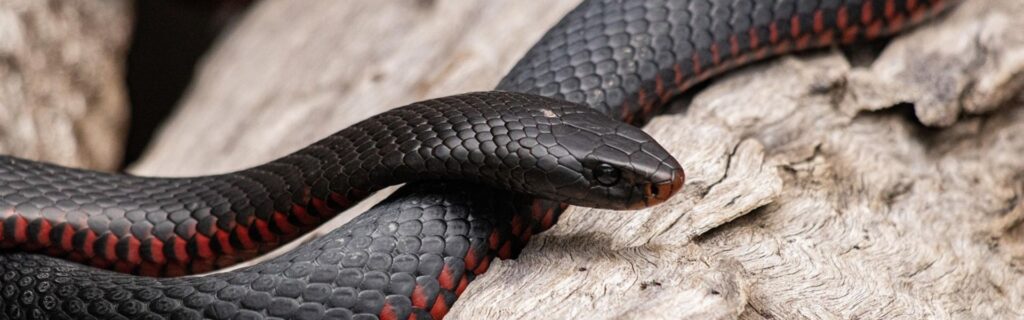
- Red-Bellied Black Snake: Iconic, shy, and usually found near creeks or swamps.
- Death Adder: The master of camouflage. Unlike others, it stays still and relies on leaf-litter cover.
The Rule: If you see one, stand still, count to five, then slowly take three steps back. Give it a wide berth and it will move on.
Keeping the Slither Out of Your Site
You don’t need a “snake-proof” fence. You just need to make your campsite the least attractive hotel in the bush.
How?
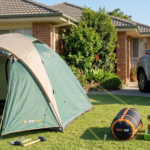
1. Site Selection: Avoid setting up right next to “snake highways”, long grass, rock piles, or large fallen logs. Choose a cleared, open area with short grass where you can see the ground clearly.
2. The Zip Rule: This is non-negotiable. If you aren’t physically stepping in or out of your tent, it must be zipped shut. A snake won’t chew through your tent, but it will absolutely slither through a 5cm gap in the door to find a cozy spot under your sleeping bag.
3. Manage Your Rubbish: Snakes don’t eat your leftover sausages, but they do eat the mice that come to eat them. Keep your food in sealed tubs and your rubbish off the ground to keep the rodent population (and their predators) away.
The Gear: Your “Snake Country” Kit
There are two items I never go bush or camping without.
1. The SMART Bandage
The #1 mistake people make during a bite is applying a bandage too loose or too tight.
- The Recommendation: The SURVIVAL Snake Bite KIT which includes the “SMART Bandage”. It has printed rectangles that turn into squares when you’ve reached the perfect tension for the Pressure Immobilisation Technique (PIT).
- Who it’s NOT for: If you are an experienced first-aider who carries bulk crepe bandages and knows exactly how to judge tension, you might not need the pictogram. But for most of us, that visual cue is a lifesaver in a panic.
2. Proper Footwear
Flip-flops (thongs) are for the beach. In the bush, you want closed-toe shoes. Most bites happen on the ankles or lower legs. High-cut leather boots or even gaiters provide a physical barrier that can turn a “envenomated bite” into a “dry strike”.
First Aid: The PIT Method
If the unthinkable happens, forget everything you’ve seen in old movies.
Do not cut the wound
do not suck out the venom
and do not apply a tourniquet.
The Pressure Immobilisation Technique (PIT):
- Stay Still: This is the most important step. Moving around pumps the venom through your lymphatic system.
- Bandage Firmly: Use a broad elastic bandage (like the SMART bandage mentioned above). Start from the fingers or toes and work your way up the entire limb. It should be as tight as you’d wrap a sprained ankle.
- Splint It: Use a branch or a tent pole to keep the limb completely still.
- Call 000: Even if you think it was a “non-venomous” snake, get to a hospital.
Complete Your Setup
Safety doesn’t end with snakes. Make sure the rest of your kit is just as solid:
- See Where You Walk: A good headlamp is your best defense against treading on a snake at night. Check our Best Camping Headlamps guide.
- The Essentials: Grab our Ultimate Summer Camping Packing Checklist to make sure you haven’t forgotten the first aid kit.
- Know Your Site: If you’re heading to a new spot, check our Campsite Directory for family-friendly (and well-maintained) locations.
FAQ: Snakes and Camping
Latest Posts
- Camping With an EV or Hybrid in Australia 2026: Can You Run a 12V Fridge?
 EVs and hybrids have no alternator, so a dual-battery setup is out. Here is how V2L actually works for camping, which AU models have it, and what a fridge costs you in range.
 - Best Camping Headlamps: From Serious Gear to Panda Faces (2026)A dead headlamp at 11pm ruins the whole trip. We’ve filtered Amazon AU down to 6 headlamps that actually hold up in Australian conditions — including the one that already converted a real sale.
- Winter Camping Australia 2026: The Sleep System & Layering GuideAU winter camping done properly. The sleep system that keeps you warm at -5C, the layers that beat cotton-kills hypothermia, the AU regions and what gear they actually need. Driveway-tested, ProductReview-cross-checked.
- First Time Camping in Australia? Don’t Make These Mistakes (2026 Guide)Most first camping trips fail on systems, not gear. Generator rules, grey water, the driveway test, and what to actually pack. The honest beginner’s guide for Australian conditions.
- How to Power a CPAP Machine While Camping in Australia (2026 Guide)Running a CPAP off-grid doesn’t need an expensive inverter setup. The right 12V cable, the right settings, and a 500Wh station will cover most people for 3–5 nights. Here’s exactly what to buy and how to set it up.